Dr Shashank Chaturvedi
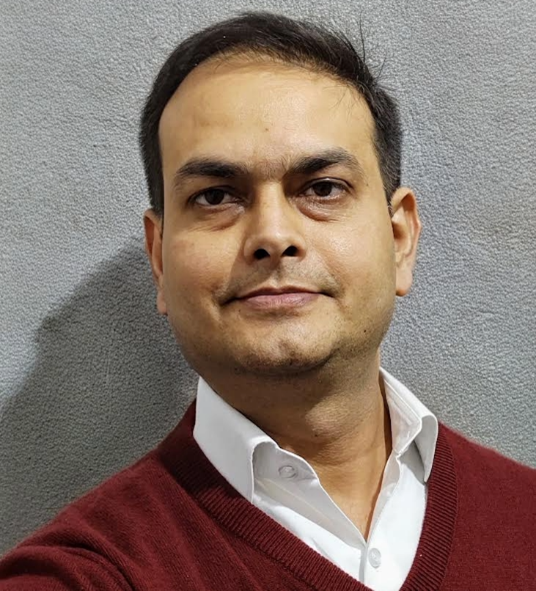
Research Affiliate
Shashank Chaturvedi is a political anthropologist whose research examines the intersections of religion, caste, culture, and politics in North India, with a particular focus on eastern Uttar Pradesh. His work combines historical and ethnographic approaches to investigate how social identities, religious institutions, political organisations, and local political economies shape processes of power and political mobilisation.
Chaturvedi is currently Co-Principal Investigator, working with Professor David Gellner (University of Oxford) and Professor Sanjay K Pandey (JNU) on the British Academy/Leverhulme Small Research Grant project “Brahmin Politics Recast: Domination, Decline, and Mobilization in Eastern Uttar Pradesh (1950–2027)” (SRG26\262357), funded under the 2026 Small Research Grants scheme. The project, which runs until September 2028, examines the historical transformation of Brahmin political influence in eastern Uttar Pradesh and the contemporary resurgence of Brahmin mobilisation in the run-up to the 2027 Uttar Pradesh Assembly elections.
He holds a PhD from the Centre for Political Studies, Jawaharlal Nehru University (JNU), New Delhi, and is currently based at the Centre for Development Practice and Research, Tata Institute of Social Sciences (TISS). Previously, he taught at Indraprastha College for Women, University of Delhi, for three years and at Institute of Law, Nirma University.
His PhD dissertation, titled Religion, Culture and Power: A Study of Everyday Politics in Gorakhpur examines micro (everyday) politics in Gorakhpur, Uttar Pradesh, as it interacts with the religious institution of the Gorakhnath Math and its Mahant (Chief priest). His research findings suggest that religion and politics combine in complex ways through the institution of Gorakhnath Math and create opportune moments for the Math to play an active role in the local politics. After his Ph D, he was a co-researcher in a project, ‘Democratic Cultures in South Asia,’ funded by the European Research Council (ERC) and Economic and Social Research Council (ESRC) based at the University College London (UCL), UK. His contribution involved analysing the transformation of the Gorakhnath Math in Gorakhpur and the affiliated educational institutions into a hub of local and regional politics in eastern Uttar Pradesh. He also investigated the causes of the rise of a nexus between the mafia and politicians in the 1980s in this region and its eventual demise in the 1990s. In addition, the research also investigated the emerging politics of development in Gorakhpur. His publications have drawn on the doctoral and UCL research projects. Two of his key research articles are, one published in Society and Culture in South Asia, Sage, 2017 and the other one is in Contemporary South Asia, Routledge 2019 (Co-authored with Prof. David Gellner, University of Oxford and Prof. Sanjay Pandey, JNU.
Earlier, as a Research Affiliate with Oxford University, he worked on the Project “Understanding the 2022 state elections in eastern UP (Uttar Pradesh), India (SRG21\211342)” supported by the British Academy (BA/Leverhulme Small Research Grants SRG 2021). Along with Prof. David Gellner (University of Oxford) and Prof. Sanjay Pandey (JNU), he came up with an article on changing nature of the BJP as an organization. Most recently, his collaborative research, supported this time by the John Fell Fund Oxford, led to a third peer-reviewed publication, in Contemporary South Asia, on the 2024 general elections in Uttar Pradesh and Gujarat (Chaturvedi, Gellner, & Pandey 2026). It focused on the limits to the BJP’s social engineering for electoral advantage in North India and one major outcome of it was in the form of a research article on the limits of BJP as an organization.
During the current project, as Research Affiliate, his collaborative research will seek to explain the contemporary resurgence of Brahmin mobilisation in the run-up to the 2027 Assembly elections in eastern UP. It will further examine how Brahmin political dominance has evolved and declined from the Nehruvian era through the post-Mandal period in Eastern UP, and how the region’s local political economy, shaped by long histories of the crime-politics nexus, landholding, and unequal access to educational institutions, contributes to sustaining Brahmin influence. He intends to produce a monograph-length study offering a historically grounded and empirically rigorous account of Brahmin politics, mobilisation, transformation, and influence in eastern Uttar Pradesh.
Contact Information