
Professor Inge Daniels
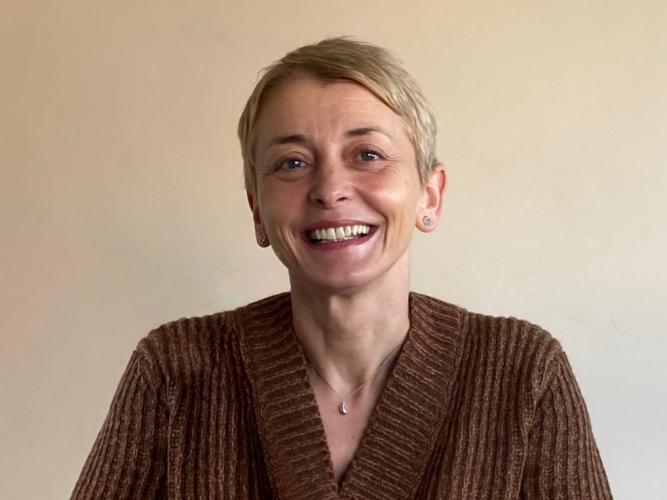
Professor of Anthropology
Fellow of St Cross College
My research is situated at the intersection of Economic, Visual, and Material Anthropology. Based on more than twenty-five years of fieldwork experience both in Japan and in the UK, it explores the ways material objects, spaces, and practices shape human experiences, identities, and relationships. Specifically, I engage with three major fields: the anthropology of housing and infrastructure, the study of material culture and economies of luck, and applied visual anthropology through experimental exhibition design, photography and film. By bridging empirical research with public engagement, my work challenges conventional disciplinary boundaries and expands anthropology's scope and societal relevance.
Awards
Oxford University Teaching Excellence Award 2014-2015
ICAS Book Prize 2013 Reading Committee Accolades / Social Sciences for The Japanese House
Oxford University Teaching Excellence Award 2007-2008
Contact
Email: inge.daniels@anthro.ox.ac.uk
Telephone: +44 (0)1865 274677
1.Anthropology of Housing: Atmosphere and Infrastructure
Since January 2020, I have served as Principal Investigator (PI) for Disobedient Buildings, funded by the Arts and Humanities Research Council (AHRC) until June 2025. This project examines the connections between housing, welfare, and wellbeing in the United Kingdom, Romania, and Norway, responding to the global rise in incidents in aging high-rise infrastructure such as the Grenfell Tower fire in London in 2017. Disobedient Buildings investigates how residents of European tower blocks create safe, comfortable homes amid infrastructural challenges. It combines anthropological research on atmospheres—a concept I have long researched—with the Anthropology of Infrastructure, while challenging the usual focus on technology-driven public projects emblematic of progress.
By focusing on housing, I aim to uncover the complex relationship between macro-level policies and everyday experiences that shape people's well-being, health, and welfare within the home. Rather than seeing infrastructure as neutral or monolithic, my approach contextualizes it as a culturally embedded and affective space where inhabitants shape, and are shaped by, their environment. My previous monograph, The Japanese House: Material Culture in the Modern Home (Daniels 2010), based on one year of immersive fieldwork within Japanese households, significantly informs this research. This book remains a foundational text in the Anthropology of the Home exploring often neglected mundane domestic practices such as storage, bathing, and cleaning, and their roles in the seasonal, relational, and affective rhythms of daily life. I emphasize the sensory and embodied aspects of home, living alongside Japanese families, and study “what it feels like” to inhabit their intimate domestic spaces.
2.Material Culture and Economies of Luck
This research, initiated during my PhD at University College London, examines how everyday, mass-produced objects shape social, spiritual, and economic relationships in Japan. My overarching aim is to challenge the assumption that material and ritual life are separate, showing how they reinforce luck, care, and relational networks in uncertain times.
The first strand focuses on Japanese gift exchange. In an influential Journal of Material Culture paper (Daniels 2009b), I argue that, beyond symbolic and social value, gifts' material qualities matter. Japanese recipients prefer ephemeral goods that create sociality while being shared. In a 2023 book chapter, I reflect on my own experiences of Japanese gifting and its broader anthropological implications (Daniels 2023). The second strand explores material aspects of Japanese spirituality. This can be traced back to an influential 2003 article on Japanese lucky objects in the Journal of the Royal Anthropological Institute (Daniels 2003). This body of work highlights the role of non-human entities, such as spirits, in sustaining social life. In Dolls are Scary (Daniels 2009b), a chapter in Material Religion, edited by David Morgan, I examine Japanese people's relationships with dolls in their homes, questioning the Euro-American concept of religion as ‘inner faith'. I also explore how Japan's commercial market sustains sacred economies. Contrary to the view that commercialisation weakens traditions, I argue that market practices and seasonal rituals are intertwined, as shown in my 2009 chapter in Time, Consumption and Everyday Life (Daniels 2009a). My 2012 article on Economies of Fortune returns to many of these themes, exploring the pivotal role Japanese married women play in caring for a multitude of human and non-human actors in order to protect their families and their homes against all kinds of calamities (Daniels 2012).
I further expand on the Economies of Luck theme in a 2024 Journal of the Royal Anthropological Institute article (Daniels 2024) on Japan's New Year's card tradition, an annual ritual circulating roughly 3 billion cards. Despite digitalisation, these paper objects sustain economic, social, and spiritual networks. I am also developing an ethnographic film on this practice as both a research outcome and a public engagement tool.
3.Public Anthropology and Experimentation with Exhibitions, Photography and Film
Public anthropology, through exhibitions, photography, and film, forms the third area of my research. My work aims to make anthropological insights accessible to non-specialist audiences, using participatory practices that encourage interaction. In 2001, I curated Souvenirs in Contemporary Japan at the British Museum, accompanying my PhD dissertation at UCL (Daniels 2001). This exhibition encouraged visitors to interact with exhibits and explore Japanese souvenir culture in multi-sensory ways. It shaped my approach to exhibitions as collaborative spaces where visitors actively engage with anthropological research. In 2011, I curated At Home in Japan: Beyond the Minimal House at the Museum of the Home, East London. This immersive exhibition recreated a Japanese apartment, allowing visitors to interact with everyday objects. Inspired by my 2003 fieldwork inside Japanese homes, it challenged exoticised views of Japan, emphasising lived experience over stereotypical minimalism. The widely attended exhibition became an impact case study for the School of Anthropology and Museum Ethnography in the 2013 REF.
To understand audience interaction with participatory exhibits, I conducted an ethnography of visitors engaging with At Home in Japan. Some of my initial findings appeared in the Bulletin of the National Museum of Ethnology, Osaka (Daniels 2013), but they were further developed in my monograph What are Exhibitions For? - An Anthropological Approach (Daniels 2019). This book demonstrates how exhibitions function as spaces for social interaction and imaginative play, where anthropological concepts can be enacted and challenged. I argue that framing exhibitions as immersive environments results in more inclusive understandings of cultural knowledge. This model repositions exhibitions as evolving sites of public anthropology.
As part of Disobedient Buildings (AHRC, 2020–2025), I also created my first ethnographic short film, She Waves at Me (Daniels 2022), which bridges anthropology, architecture, and ageing studies. The 20-minute film captures overlooked details of ageing bodies and ageing buildings, showing how older adults navigate neglect and decay while maintaining their homes and lives, while revealing deep entanglements between people, architecture, and care. The film has been widely recognised, screening at academic seminars and conferences across the UK, Germany, Japan, Sweden, Finland, and the US. It was a finalist at the Rotterdam Architecture Film Festival (2023) and Istanbul Architecture and Urban Film Festival (2023), demonstrating its impact beyond anthropology into architecture and urban planning. It has also been used by the charity Age UK in public discussions on wellbeing and health among older urban residents.
Finally, during the Covid-19 pandemic the Disobedient Buildings Team also successfully experimented with innovative methods and new dissemination channels for anthropological knowledge. Between 2021 and 2023 we completed two Disobedient Buildings Podcast series (13 episodes); see Disobedient Buildings podcast. Since October 2024 the Disobedient Buildings Pack Methodology Toolkit that allow researcher to study homes from afar is accessible online at Disobedient Buildings Toolkit: Pack Methodology
Areas of expertise
Economic, Visual, Material Anthropology, Anthropology of Space and Built Environment, Anthropology of Japan (East Asia), Ethnography, Exhibitions.
Teaching
- Option: Objects in Motion – Current Debates in Visual, Material and Economic Anthropology. Website.
- MSc/MPhil Social Anthropology
PROFESSIONAL ACTIVITIES
Editor in Chief TRAJECTORIA: Anthropology, Art and Museums
External examiner
- MA History of Design at the Royal College of Art in London (2013-2015)
- MA in Material and Visual Culture at University College London (2014-2016)
- PhD Dissertations in Social Anthropology at UCL, LSE and SOAS
Pre-publication Reviewer
The Journal of the Royal Anthropological Institute, The Journal of Material Culture, Environment and Planning: Society D, Material Religion, HAU, Journal of Consumer Research, Consumer Culture, Historical Geography, and Human Organisation.