
Anthropology Research Bulletin
Welcome
Here you will find details of current funding opportunities and support that may be of interest to members of SAME and other Anthropologists at Oxford University.
Before applying to any of the research funding opportunities mentioned here please contact research@anthro.ox.ac.uk
We will advise on eligibility, school process, timeframes and more.
Please give us as much notice as possible if you need application support - we may have limited capacity to take on new grant applications closer to scheme deadlines.
If you have any items you would like added to this page please contact research@anthro.ox.ac.uk
Highlights
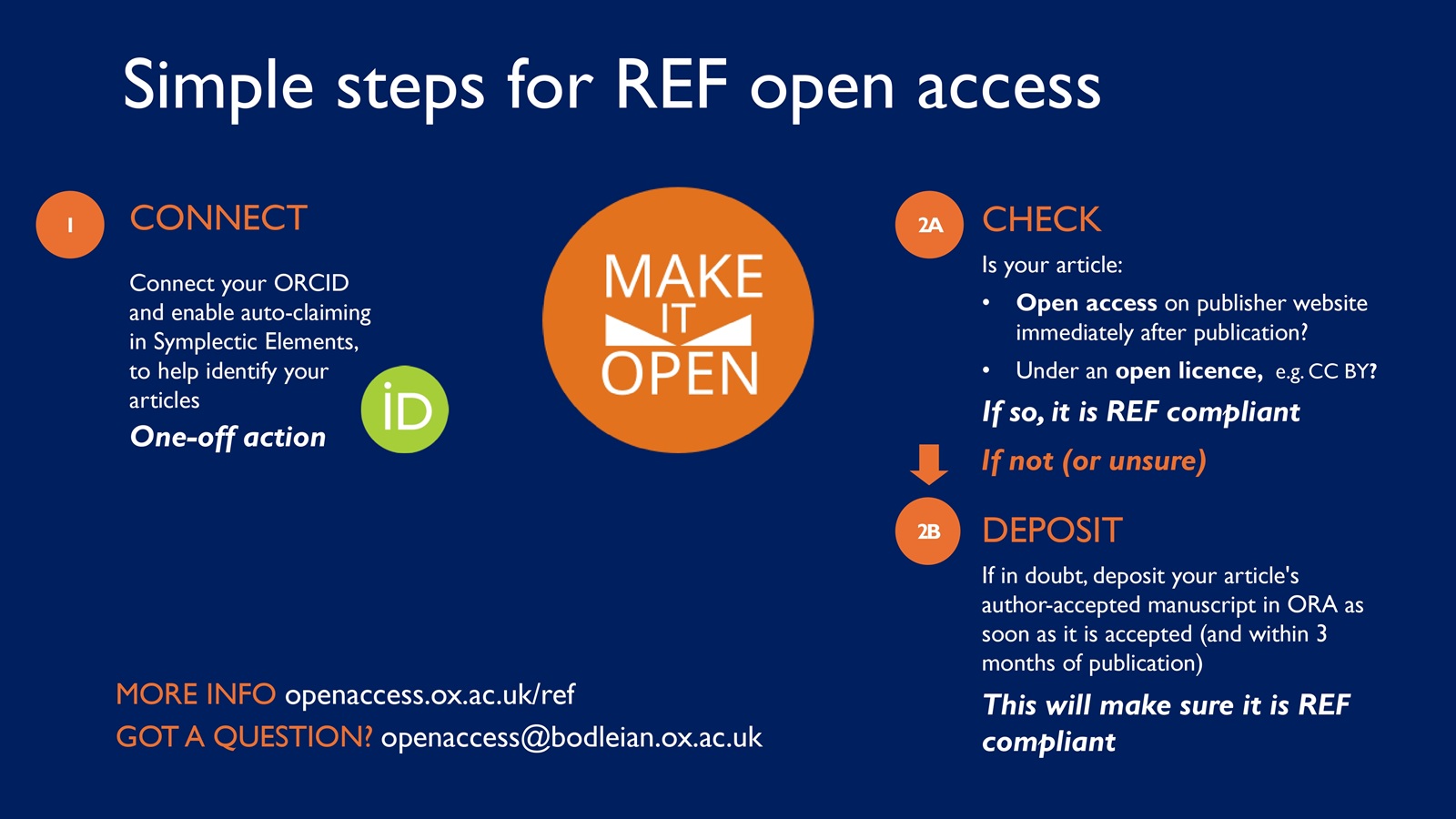
Connect | Check | Deposit
Attention all academics, researchers, and graduate research students at Oxford who publish in journals:
New open access requirements for the Research Excellence Framework (REF) have come into force for any articles published from 1 January 2026. The REF is a national assessment of research quality. It informs how public funding for research is allocated to universities in the UK.
The REF requires journal articles and conference papers (with an ISSN) be made open access, either by the publisher or the author. (Books and other forms of publication do not need to meet these requirements.)
Remember: you do not necessarily need to pay in order to make your articles open access! Authors can do so by 'self-deposit' on Symplectic Elements, the University’s system for recording research outputs and depositing them in the Oxford Research Archive (ORA).
Depositing your outputs through SE helps ensure that your research is made openly available where possible and supports the University’s open access requirements. Once deposited, ORA staff will review the full text and metadata and make them available in accordance with copyright and publisher policies.
Please remember to deposit your outputs in SE as soon as they are accepted for publication.
Funding Opportunities
Oxford Martin School 2026–27 Funding Call
The Oxford Martin School is requesting proposals from eligible applicants for solutions-focused research programmes that could have a major impact on this and future generations. The scheme is looking for adventurous “high-risk high-reward” ideas that would not be fundable through standard research council or related routes.
The deadline for the EOI stage is 27th January 2027. Please contact research@anthro.ox.ac.uk by 2nd November 2026 if you are interested in applying to this call.
John Fell Fund - Michaelmas Term 2026
The deadlines for requesting costing support for this scheme are now passed.
Environment Impact Acceleration Account
The Environment IAA is open to University of Oxford researchers who are undertaking environment-related research across any disciplinary area. Supported through the University’s Strategic Innovation Fund, the scheme is designed to accelerate the impact of environmental research beyond academia. The call has three funding schemes; it will run across three funding rounds. The School is able to support applications to the funding rounds in January and May 2027; please contact research@anthro.ox.ac.uk if you are interested in applying to this call.
Pre-announcement: Humanities Impact Acceleration Account (IAA) - Coming Soon
The University will soon be launching a new internally-funded Humanities Impact Acceleration Account, aimed specifically at realising impact from humanities research. It will be managed by the Humanities Division but open to humanities scholars across the University. More information will be released soon.
Hazem Ben-Gacem Tunisian Collaboration and Research Grants
This award, of up to £5,000 each, is open to DPhils and academics working in the fields of humanities or social sciences at the University of Oxford, with the aim of supporting field research in Tunisia and collaborative projects with Tunisian scholars. All application materials should be sent by email to tunisia-oxford@sant.ox.ac.uk. Rolling deadline.
Funding opportunities for Policy Engagement
The University of Oxford offers dedicated funding for policy engagement, supporting policy-relevant projects, project components, partnerships, and events. Colleagues can also access information on external funding opportunities for policy-facing work.
Please contact research@anthro.ox.ac.uk if you are interested in applying to any of these calls.
To discuss any of these options further, contact the Policy Engagement Team at researchandpublicpolicy@admin.ox.ac.uk.
None at the moment.
British Academy Early Career Researcher Network
The University of Oxford is now a consortium partner of the British Academy Early Career Researcher Network (BA ECRN) – South East branch. The BA ECRN is a network to help, support, develop and empower early career colleagues undertaking Social Sciences, Humanities and Arts (SHAPE) research in the UK. Any colleague with up to 10 years of research experience in SHAPE disciplines since obtaining their PhD (or equivalent) and who is based in the South East region can sign up to the network.
Membership provides access to:
- Transdisciplinary and inter-institutional networking that could lead to new research collaborations
- Seed funding for research projects (up to £5K)
- Up to £300 for development outside of BA ECRN activity or conferences
- Travel funds to attend BA ECRN events
Talent Development Awards 2026-27
The deadline for requesting support for this scheme is now passed.
British Academy/Leverhulme Senior Research Fellowships
If you are interested in applying to this scheme, please confer with the Head of School and Head of Administration and Finance in the first instance.
This scheme enables established scholars in the humanities and social sciences to take one year of research leave to complete a significant piece of research. The fellowships cover the cost of replacement teaching and provides limited research expenses. The funder deadline for this call is 11th November 2026. Please contact research@anthro.ox.ac.uk by 15th October 2026 if you wish to apply.
Innovation Fellowships Scheme 2026 – Route B: Policy-Led (FCDO)
The British Academy is inviting applications for Policy-Led Innovation Fellowships in partnership with the Foreign, Commonwealth & Development Office (FCDO) and Cabinet Office. The scheme supports early- and mid-career researchers in the humanities and social sciences to work directly with policymakers on contemporary policy challenges. Awards of up to £120,000 are available for 12-month fellowships. The funder deadline is 18th November 2026. Please contact research@anthro.ox.ac.uk by 15th October 2026 if you wish to apply.
Leverhulme Trust Early Career Fellowships 2026–27
The Leverhulme Trust Early Career Fellowships 2026–27 scheme is not yet open. It is anticipated that there will be a gathered field process through SAME, with further details to be announced towards the end of October.
Information about gathered field calls for postdoctoral fellowships, including current opportunities and individual calls, is available on the SAME Postdoctoral Research webpage.
Researchers interested in applying are encouraged to check the webpage regularly for updates.
Wellcome discovery research awards
For SAME Staff only:
The School invites SAME staff members interested in applying for Wellcome discovery research awards to submit an Expression of Interest (EOI). This will help us identify prospective applicants at an early stage and ensure that appropriate demand management, support, advice, and resources can be put in place.
Submitting an EOI to the Research Support team does not constitute a commitment to submit a Wellcome scheme proposal through the department.
If you are considering a Wellcome application, please complete the Expression of Interest form by 17 October 2026 to research@anthro.ox.ac.uk.
Funding opportunities are listed on the EU Funding and Tenders portal. Please contact research@anthro.ox.ac.uk if you are interested in applying to any open calls.
ERC Frontier Grants 2026-27
For SAME Staff only:
The School invites SAME staff members interested in applying for an ERC Frontier Grant (including ERC Consolidator, Synergy, or Advanced Grants) in 2027 to submit an Expression of Interest (EOI). This will help us identify prospective applicants at an early stage and ensure that appropriate demand management, support, advice, and resources can be put in place.
Please note that the Gathered Field for the ERC Starting Grants 2027 has now been completed. This EOI is for all other ERC Frontier Grant schemes with upcoming deadlines.
Submitting an EOI to the Research Support team does not constitute a commitment to submit an ERC proposal through the department.
If you are considering an ERC application, please complete the Expression of Interest form by 17 October 2026 to research@anthro.ox.ac.uk.
Horizon Europe
Horizon Europe offers funding for collaborative and investigator-led research across a wide range of disciplines, including the social sciences and humanities. Colleagues interested in applying for Horizon Europe funding should consult the European Commission's Funding and Tenders Portal for currently open and forthcoming opportunities.
Please contact research@anthro.ox.ac.uk as early as possible to discuss eligibility, departmental support, and internal application deadlines.
Note 1: UKRI is currently reviewing its funding portfolio to transition to a new investment framework. Links for more information: More information about UKRI review of investment approach, pause in funding calls and an open letter from Ian Chapman (UKRI)
ESRC is making important changes to our applicant-led mode schemes to ensure the brightest ideas can be pursued. The refreshed approach will encourage agility, innovation and excellence across all stages of research, from early-stage exploration to major programmes. ESRC organised a Town Hall regarding these updates on 30th September, the link to the recording is available here.
A second Town Hall is expected to take place on the same topic, and the registration link will be updated when received.
Pre-announcement: ESRC applicant-led: grow awards
Apply for funding to make a step-change in your career. Grow awards support individual researchers at key career points to develop capabilities or pivot direction, strengthening the UK’s social science research base. This call is expected to open on 5th November 2026.
Note: This is a funding opportunity being introduced as part of the applicant-led mode scheme changes, replacing the ESRC Responsive Mode schemes.
Pre-announcement: ESRC applicant-led: explore awards
Apply for funding to advance knowledge through ambitious, curiosity-driven social science. Explore awards support individuals or small teams to pursue bold, novel ideas within ESRC’s remit that advance knowledge. This call is expected to open on 5th November 2026.
Note: This is a funding opportunity being introduced as part of the applicant-led mode scheme changes, replacing the ESRC Responsive Mode schemes.
Pre-announcement: ESRC applicant-led: challenge awards
Apply for funding to bring people, expertise and ideas together in ambitious, larger-scale programmes. Challenge awards tackle major research, economic and societal challenges, generating impactful knowledge and innovation.
Note: This is a funding opportunity being introduced as part of the applicant-led mode scheme changes, replacing the ESRC Responsive Mode schemes.
UKRI Translation: AHRC Proof of Concept
UKRI Translation: AHRC Proof of Concept supports arts and humanities activity that translate previously funded AHRC/UKRI projects into real world economic, societal, cultural or policy impact. This opportunity was previously known as AHRC responsive mode: follow-on funding for impact and engagement. Open call – no closing date.
Daphne Jackson Fellowship
These fellowships are for those looking to return to a research career after a break. You must be eligible for UKRI funding. Open call - no closing date.
AHRC responsive mode: Curiosity Award
Flexible awards to fund fundamental research that leads to new research agendas, networking activity and idea generation, which enables the development of further research opportunities and new research agendas. Please contact research@anthro.ox.ac.uk if you plan to apply. Open call - no closing date.
AHRC responsive mode: catalyst awards
AHRC awards to support researchers without prior experience of leading a significant research project to accelerate their trajectory as independent researchers, to unlock their potential and build leadership and convenor experience. Please contact research@anthro.ox.ac.uk if you plan to apply. Open call - no closing date
Links to rolling calls:
- Wenner-Gren Foundation
- Royal Anthropological Institute
- Harry Frank Guggenheim Foundation
- The Leakey Foundation
Please contact research@anthro.ox.ac.uk if you are interested in any upcoming schemes. Please note that departmental and institutional deadlines will apply.
Links to Social Sciences Divisional Term cards
Link to Term Card for Michaelmas Term 2026 (SSO required). See the term card and relevant SharePoint pages for further information and booking details.
The Social Sciences Division Research, Impact & Engagement Team is offering a programme of research training throughout Michaelmas term. Sessions cover research funding, grant development, impact, open research, and research culture.
Upcoming sessions include:
- 21 October, 10–11am: Research Culture in Funding Applications
- 22 October, 11–11.45am: Consultancy, Collaboration or Something Else?
- 27 October, 11am–12.30pm: Introduction to the Funding Landscape
- 3 November, 11am–12pm: Research Funding for Social Scientists
- 11 November, 12.30–2.30pm: Impact Forum
- 11 November, 3–4pm: Budget and Workplan in Research Grant Applications
- 17 November, 3–4pm: Leverhulme Trust Early Career Fellowships Information Session
- 26 November, 11–11.45am: Open, but on what terms? A Practical Introduction
- 8 December, 2–3.30pm: How to Evidence Research Impact for REF2029 and Project Reporting
- 10 December, 10am–12.30pm: Pilot: Evaluating Research Culture
Communications training: SSD also offers ongoing training in writing for The Conversation. Please see SharePoint for the current schedule.
The programme also highlights the ESRC Festival of Social Science (17 October–7 November), including a Festival Family Day at the Pitt Rivers Museum on 30 October.
Research Impact and Engagement term card: Training and Resources
Subscribe to the SSD Digest via their SharePoint.
Before applying to any of the research funding opportunities mentioned here please contact research@anthro.ox.ac.uk
We will advise on eligibility, school process, timeframes and more.
Events for researchers at SAME
Please see the School's events page for information on upcoming seminars and talks.
Upcoming Training Opportunities, Resources and Surveys for all Staff and Students
AHRC – Engaging with Government Course 2027
AHRC is inviting applications for its Engaging with Government course. This free, three-day programme provides researchers with an introduction to policymaking processes and explores how academic research can inform public policy. Participants will develop their understanding of policy engagement and strengthen their communication and influencing skills.
The course is open to arts and humanities researchers at all postdoctoral career stages. Places are awarded through a competitive application process. The deadline for application is 29th October 2026.
Get involved in the Oxford Brookes Science Bazaar 2027
Planning is underway for the Oxford Brookes Science Bazaar 2027, taking place on Saturday, 20 February 2027, at Oxford Brookes University’s Headington Campus.
The Science Bazaar is Oxford Brookes’ flagship public engagement festival, welcoming more than 10,000 visitors for a day of hands-on science, creativity, and discovery. University of Oxford researchers and students are invited to get involved by running an interactive activity, demonstration, or research exhibit, volunteering on the day, or sharing the opportunity with colleagues.
Exhibitor sign-up deadline: 18 December 2026.
Find out more and register to take part via the Science Bazaar website.
AI Opportunity for Researchers
OpenAI have introduced ChatGPT for Academic Researchers, offering a limited amount of free Pro-level accounts to eligible researchers for up to one year. The University of Oxford has been offered a small number of these seats for our research community.
Participants will receive free access to frontier models across ChatGPT, ChatGPT Work, and Codex, including the GPT‑5.6 family of models at launch. They will also have expanded deep research, higher usage limits, and larger context windows. Together, these capabilities support scientific reasoning, agentic execution, and research workflows across disciplines.
There are strict eligibility criteria for this and all decisions are made by OpenAI, not Oxford. There is no timeframe for when final decisions will be made or when access to the new ChatGPT for Academic Researchers workspace will be provisioned but this new workspace will come with the same enterprise protections as Oxford’s ChatGPT Edu workspace.
Interested researchers can apply to join the waitlist.
Aspect Training – Autumn 2026
Aspect (A SHAPE Platform for Entrepreneurship, Commercialisation, and Transformation) is a network of organisations, including the University of Oxford, united by a belief in the boundless creativity and vitality of research within the Social Sciences, Humanities, and Arts (SHAPE) disciplines.
The Aspect Autumn 2026 training programme is now live, with a range of courses designed to help researchers in the Social Sciences, Humanities, and Arts (SHAPE) develop entrepreneurship, commercialisation, and enterprise skills to translate research into real-world impact.
As the University is an Aspect Hub member, training is free, although some courses have a limited number of places per institution, allocated on a first-come basis.
Upcoming courses include:
- Creative Technology Series 2 – Six practical sessions on using AI and digital tools in research and project work. 13 October–5 November. Register here
- Developing SHAPE Projects for Governments and NGOs – Practical tools for developing and commercialising SHAPE projects with government and NGO partners. 20 & 22 October. Register here
- Piloting for Validation – Design a partner-led pilot to validate your project’s impact potential. 11 & 17 November. Register here
- Protect It, Prove It, Spin It – A practical guide to intellectual property protection and spin-out decisions for SHAPE ventures. 12 & 19 November. Register here
- SHAPE Resources and Pathways – Explore routes for translating SHAPE research into impact, with optional mentoring. 25 November, with mentoring sessions in December. Register here
For courses with limited Hub places, a waiting list is also available.
Changes to the Open Science Framework (OSF)
Changes to the Open Science Framework (OSF) will reduce some of the platform’s functionality over the coming months. In particular, OSF Projects is being phased out as an active workspace. From 16 November 2026, users will no longer be able to create new projects or components, and from 19 February 2027, existing projects will become read-only. Other OSF services, including preregistration and preprint servers, will continue.
The Bodleian Libraries have published guidance for Oxford researchers on the changes and recommended next steps.
Questions can be directed to osfenquiries@bodleian.ox.ac.uk.
New Open Research Training – Michaelmas Term
The Office for Open Research is introducing new courses through the Bodleian iSkills programme.
Basics of Open Research introduces practical approaches to making research more transparent, accessible, collaborative, ethical, and publicly engaged across a range of disciplines.
Book here.
Basics of Open Science focuses on making scientific research more transparent, accessible, reproducible, and reusable, covering areas including preregistration, open methods, reproducible workflows, open data, open code, preprints, and open access.
Book here.
A new three-part Getting Published pathway is also being developed, covering preparing research for publication, publishing your work, and editing and peer review. The first module is due to run in Michaelmas term.
See the latest iSkills courses and booking information here.
Insights from diamond open access publishing at Oxford
What if research could be free to read and free to publish? This panel discussion on 26th October 2026 will explore diamond open access publishing, where research is made freely available without subscription fees for readers or publication charges for authors.
Editors from Oxford diamond open access journals, including journals hosted through SHOx (Shortform Hosting at Oxford), will discuss the benefits and practical challenges of the model, financial sustainability and journal independence, and the future of diamond publishing. The session will also include live polls and audience Q&A.
Register through this link to attend.
National Centre for Research Methods – Qualitative and Social Research Training
The National Centre for Research Methods (NCRM) offers a programme of training courses, workshops, and resources for researchers working across the social sciences. Training covers a wide range of quantitative, qualitative, and mixed-methods approaches, including qualitative interviewing, thematic analysis, ethnographic research, reflexivity, participatory methods, and research design.
These opportunities may be relevant to SAME colleagues seeking to develop or refresh methodological skills, including early-career researchers and those undertaking interdisciplinary projects. Colleagues are encouraged to consult the NCRM training calendar for forthcoming courses, availability, fees, and booking information.
Ongoing Professional Development and Support
The Academic Writing Community is a drop in writing group for SSD DPhils and Early Career Researchers which meets weekly during term time.
SHOx: Oxford’s new platform for shortform scholarly publishing
The Bodleian Libraries is delighted to launch SHOx (Short-form Hosting at Oxford), a new hosting service supporting Oxford's community of scholars in publishing short-form research titles such as journals, working paper collections, and conference proceedings. Developed in partnership with the Public Knowledge Project (PKP), SHOx offers an intuitive, open-source publishing workflow through Open Journal Systems (OJS), ensuring full control over editorial processes and peer review. As a diamond open access platform, SHOx enables free publishing and reading for all, enhancing visibility, accessibility, and impact of Oxford research. Staff and student-led titles are invited to join this growing community for scholarly publishing at Oxford.
Other Opportunities and Support
Research Fellowship in the Anthropology of Forced Migration
Deadline: 24 October 2026, 1pm
St John's College and the Refugee Studies Centre at Oxford are inviting applications for a four-year Research Fellowship in the Anthropology of Forced Migration from October 2027.
The fellowship provides an opportunity for an early-career researcher to establish an independent research profile while contributing to the research and teaching activities of the Refugee Studies Centre.
Applicants should have recently completed, or be close to completing, a doctorate and have a research record in forced migration.
Dedicated careers support for Oxford researchers to continue: Following the previous update that dedicated careers support for research staff would end in August 2026, the Careers Service is pleased to confirm that funding has now been secured to continue this provision for a further three years.
Please access the Careers website online.
The courses are hosted in Canvas and are self-paced. They contain a wealth of general and Oxford-specific guidance and have been co-developed with Oxford researchers. There are currently five courses available, and the final two courses will become available during Michaelmas term:
- Research Integrity, Ethics and Governance at Oxford (a separate, introductory course to the mandatory research integrity course)
- Open Research Practices
- Research Design (coming soon)
- Collaboration
- Data
- Authorship, Publication and Peer Review
- Engagement and Impact (coming soon)
A certificate of completion will be issued for each course upon passing a short quiz and submitting a feedback survey. If you have any questions about the courses or about research practice in general, you can contact the Research Practice team: research.practice@admin.ox.ac.uk
Research Support Team
We are here to discuss potential research applications, or for discussions around next steps in your research career. We offer:
- Research Strategy discussions
- Planning for new or substantial research funding
- Postdoctoral/Early-career researcher advice
- Guidance on funding opportunities
- Eligibility checks for internal and external schemes
- Advice on SAME or SSD approval processes
- Information on Oxford application processes and demand management
- Reviews for application drafts
- Guidance on application portals
- Support with interview preparation
- Support with research budget planning
- Provision of X5 budget drafts
- Advice on Research Services approval processes
- Support with award acceptance