The Afterlives of Captured Objects: Reanimating the Gaidinliu Collection digitally
New exhibition, curated by Professor Clare Harris, opens 27 November
Pitt Rivers Museum, 27 November 2026 - 31 August 2027
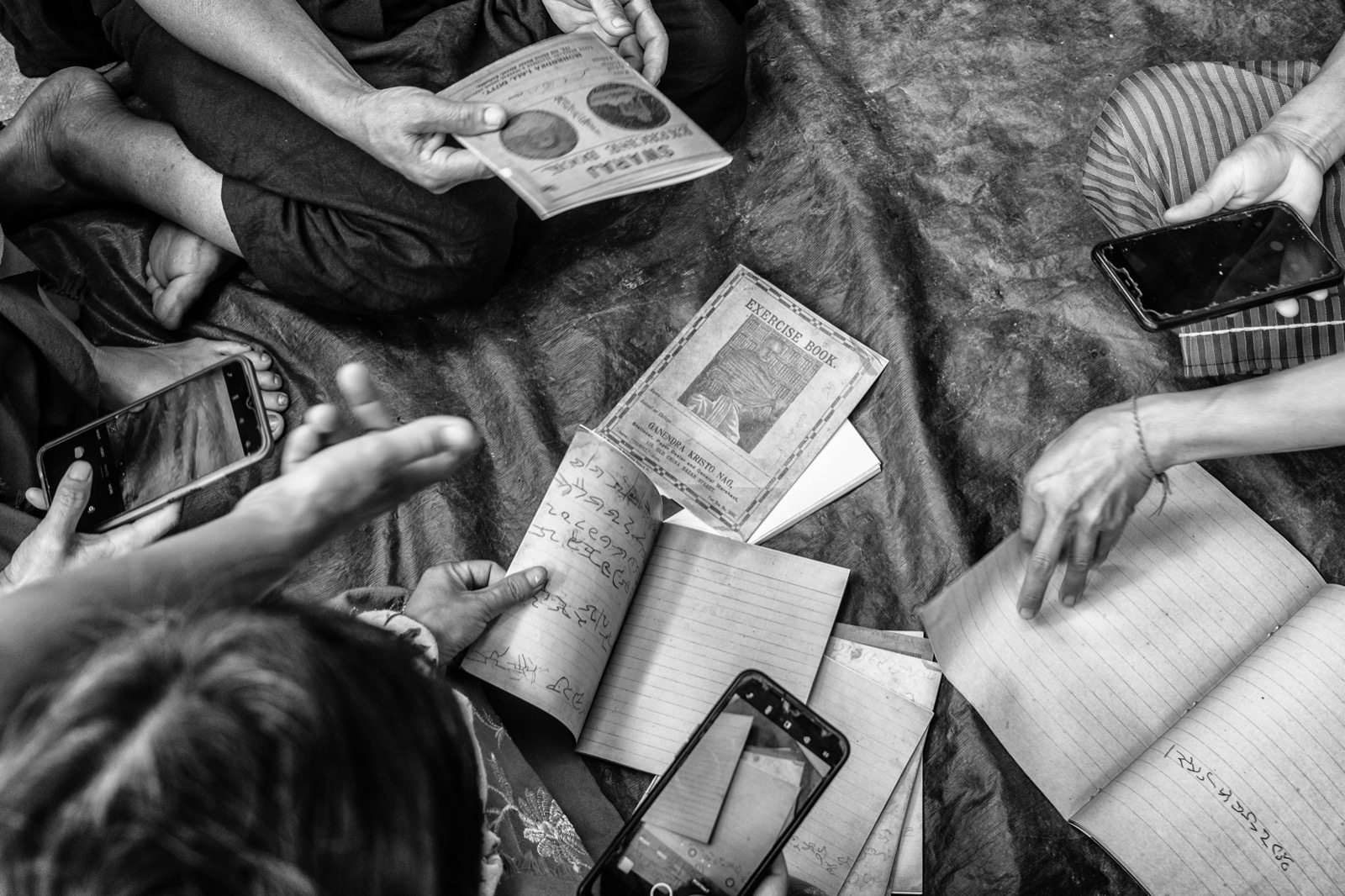
Naga women photographing copies of Gaidinliu’s notebooks, Assam, India, 2023.
Photographer: Tarun Bhartiya.
About the exhibiton
In 1932 a seventeen-year-old Naga girl called Gaidinliu was arrested for leading an uprising against the British in northeast India. She was incarcerated and her possessions were captured by British colonial officers. They were then sent to the Pitt Rivers Museum where they have been stored ever since as the ‘Gaidinliu Collection’. The entire collection will be put on public display for the first time in this exhibition.
The Gaidinliu Collection consists of 27 objects that were taken by colonial officers as they chased Gaidinliu through the hills and valleys of her homeland in their attempts to arrest her. It includes some of her dress and body ornaments and a basket containing the notebooks in which Gaidinliu wrote her prophetic visions as the leader of a Naga Indigenous religion.
Over the course of a four-year project called DiMuse, researchers from India and the universities of Edinburgh and Oxford digitised the Gaidinliu Collection in order to reach as many stakeholders as possible. Using experimental digital methods, the project facilitated access and consultation with Gaidinliu’s family and other community members across the three states of India where the Naga people currently live. When shared with Naga community members via workshops, pop-up exhibitions, creative activities and social media practices, the Gaidinliu Collection took on a new life.
This exhibition brings the original objects that belonged to Gaidinliu into the same space as film, photography and the work of contemporary Naga craftspeople to reflect Naga community responses to the Gaidinliu Collection. It tells Gaidinliu’s story through her possessions and their afterlives when reanimated by her family, her followers and Naga communities today. Using innovative decolonial display methods, The Afterlives of Captured Objects exhibition raises challenging questions about the extraction of objects from Indigenous communities in the colonial period and what the appropriate future may be for the Gaidinliu Collection.
Gallery


About Gaidinliu (1915-1993)
Born in Manipur in 1915 to a Rongmei Naga family, Gaidinliu became a revered religious and political leader known to many as ‘Rani’ or queen.
In the late 1920s, Gaidinliu and her cousin Jadonang led an uprising in northeast India. Its purpose was to oust the British from the region, stop the spread of Christianity and promote a Naga Indigenous religion. To suppress this movement, the British government in India sent in the army. In 1931, they arrested and executed Jadonang. Gaidinliu went into hiding until she too was captured in 1932. She was just seventeen when she was imprisoned by the British and was only released from jail after Indian independence in 1947.
Following her release from prison, Gaidinliu became a prominent public figure working for the upliftment of her people. She acted as the spiritual guide for followers of Heraka, the Indigenous religion she led, and as the head of a political movement advocating for recognition of a Zeliangrong Naga homeland across three states of northeast India: Nagaland, Assam and Manipur. In 1982 she was awarded one of the highest honours of the Indian government: the Padma Bhushan.
Since her death in 1993, Gaidinliu has continued to be celebrated as a charismatic female Naga leader and an important figure in the anti-colonial movement that led to Indian independence.
About The DiMuse Project
Decolonising the Museum: Digital Repatriation of the Gaidinliu Collection from UK to India
Led by Professor Arkotong Longkumer (University of Edinburgh) and Professor Clare Harris (University of Oxford), DiMuse was an AHRC-funded research project conducted between 2022 and 2026 that worked with the Gaidinliu Collection to explore the concept and practice of ‘digital repatriation’. Its aim was to engage with members of Naga communities in northeast India by 'returning' digital copies of the objects in the collection and collaborating with them to share and co-produce knowledge. The project sought to investigate the potential of this form of repatriation within the wider practice of decolonising museums.