
'I am a Human Scientist, and I always will be'
Recent graduate Teagan M Riches on what makes Human Sciences so special.
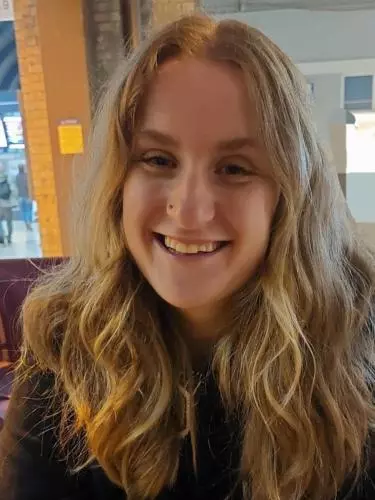
In a world that expects young people to put themselves into a box at a very young age, Human Sciences celebrates and encourages diverse interests... In an increasingly unstable world and job market, this is something I will always be grateful for.
Introduction
My name is Teagan, and I graduated from the Human Sciences degree programme in 2023. I want to share my experiences of studying Human Sciences and the impact that studying this degree has had on my life, in the three years since I graduated.
Directly after graduating, I went on to study for a master's in Bioarchaeology. I specialised in stable isotope analysis, using it to explore the relationship between humans and animals. I am now a third-year PhD student exploring youth activism for socioeconomic and spatial equity. I have worked as a research assistant evaluating community-based anti-poverty initiatives and currently work coordinating a climate and health resilience research network. Alongside this, I have volunteered as an NHS young researcher with Barnardo's and am also a participant on UN Women UK’s GenEqual programme. It may seem like an eclectic mix of interests, and you may wonder ‘So are you an archaeologist? A social scientist? A gender equality activist? Or an anti-poverty researcher?’.
My reply to you would be that I am a Human Scientist, and I always will be.
The degree
Human Sciences is such a dynamic and exciting degree programme. No two weeks were ever the same; some days I would have a lecture on the molecular genetics of cancer, followed by one on the idea of gift-giving in anthropology and rounded off by a tutorial on whether animals use tools. As a Human Scientist, you are expected to have the curiosity and capacity to understand and explore how different subjects interlink and to apply multidisciplinary thinking to real-life issues. I was also encouraged to explore what a geneticist could teach a demographer, how a sociologist, biologist and anthropologist could work together to address an issue such as COVID-19 and what the fossil record could help us understand about modern-day human behaviour.
Every week, I met with at least two different tutors from at least two different subjects. Across three years, I had the privilege of being taught by over 23 different tutors, and even more lecturers. This not only enabled me to experience a breadth of different teaching styles and learn from individuals with diverse perspectives, but it also taught me how to communicate with a wide range of people, organise my time, and quickly develop professional relationships with new people. These skills have been critical as I have moved forward and have enabled me to not only apply for new opportunities in new spaces, but to be able to enter those spaces with the confidence that I will be able to communicate with and work alongside the new people that are there.
Taking a risk?
When I was in sixth form, taking an academic route was seen as a big risk. I come from a low-income background and believed that university wasn’t for kids like me, that the financial risk was too high, especially if the degree you were studying didn’t have a profession and therefore a relatively stable job attached to it.
What I have actually found is that Human Sciences has opened up more pathways and opportunities for me than I believe would have ever been available if I had studied something else. Not only that, but I have had the unique opportunity to already change my path from archaeological research to anti-poverty research, something that Human Sciences made possible.
In a world that expects young people to put themselves into a box at a very young age, Human Sciences celebrates and encourages diverse interests, equipping you with the knowledge, skills and tools needed to transition into, out of and between different fields and career paths. In an increasingly unstable world and job market, this is something I will always be grateful for.
The community
An openness to new ideas, perspectives and connections is reflected not just in the teaching, but also in how accessible and welcoming the Human Sciences degree is. I started my degree during COVID, a weird time to start university, a scary time for the world, and an oddly exciting time to be a Human Scientist. I found I could link just about every discipline I was studying to the situation unfolding around me. Despite the pandemic and all the distancing it brought, there was always a strong sense of community. I could tell that every member of staff was just as enthusiastic about the course as myself and my fellow students.
My friends on the course all had such different interests and have gone into a range of different careers, including journalism and medicine. Despite our diverse interests, we always find something that interests us all to talk about, and that is something that also makes this degree so special. Human Scientists are always on hand to help each other out, and I hope that even the simple fact that Human Scientists, both young and old still refer to both themselves and each other as ‘HumScis’ despite diverse career paths, shows the positive and profound impact studying this degree has on us all. It is not just something we did; it is something we identify as no matter what our jobs are today.
The value
In response to contemporary issues, people are increasingly turning to the idea of interdisciplinary working. They often see it as a novelty and are unsure how it could work. I find myself thinking, 'What is all the fuss about? Of course you’d look at things holistically. Of course you’d read across disciplines. Doesn’t everyone?'
It is in these moments that I realise how privileged I am to have studied Human Sciences. The only way to tackle problems like health inequalities or climate change is to tackle the problem together, from a multidisciplinary angle.
Human Sciences was never a risk, but the greatest opportunity of my life.
Explore more
Human Sciences
More about the undergraduate degree and research from the Institute of Human Sciences


